




Human life consists of a sequence of countless choices extending from birth to death. Every morning, we wake up to a new day, make different decisions, and experience the consequences of these decisions. Sometimes we succeed, while at other times different situations arise. So, have you ever stopped and thought? When you look back, were all these decisions we made and the time flowing by merely a chain of possibilities? Or had everything that would happen been determined from the very beginning? Are we the witnesses who experience these events when their time comes?
To ask on an even more fundamental level: Does the thing we call time really exist? Or is time, like all our other perceptions, merely one of the ways our mind interprets the world? Do all the events we have experienced up to now consist of random happenings? Or does that created, flawless order we see in the universe also apply within time? Are the past, present, and future truly separate from one another, or are they all parts of a single whole that exists at the same time?
It is precisely at this point that we encounter that great concept: Destiny.
Destiny
A moment, an event that will last only one second... Yet one of the greatest secrets of the universe is hidden within this moment. Destiny is God’s creation of the universe, life, the past, and the future that has not yet been lived, within a single moment. Time and space are concepts that are not absolute, that have beginnings, and that God created from nothing. God, Who creates time and events, is beyond all these limitations.
In order to truly comprehend that magnificent and complex fabric of destiny, we must understand the two fundamental pillars upon which the universe is built: Time and will.
Let us begin this journey with the first and most mysterious one. Let us descend into the depths of time. But on this journey, we will need not only thoughts, but also the unshakable facts of physics, astronomy, and mathematics.
Time
Most of us think that planets were discovered simply by observing the sky through telescopes. Yet the truth is far more interesting. Some planets were discovered through mathematical formulas on paper before anyone had ever seen them. Isaac Newton’s laws of physics told us that the universe operated like a clock. If there was a small deviation in a planet’s orbit, you could use Newtonian physics to calculate where the hidden mass causing that deviation was located.
Indeed, that is exactly what happened. When the strange deviations in Uranus’s orbit were noticed, mathematicians said, “There must be something there,” and pointed with their fingers to a spot in the sky. Neptune was found precisely at that calculated point.
The same success story was expected to be repeated for Mercury. There was also a persistent deviation in Mercury’s orbit that did not conform to Newtonian mechanics. The scientific world was certain: there had to be another planet, not yet seen, between the Sun and Mercury. They had even given it a name: Vulcan. However, there was a problem. Astronomers scanned the sky for years, searching for that mysterious mass beneath the glare of the Sun, but Vulcan was not there. Mercury seemed to be pushed beyond Newton’s laws by an invisible hand. In time, this truth emerged: the problem was not a missing planet; the problem was a missing theory.
In Newton’s universe, time was an absolute concept that flowed at the same rate for everyone. Wherever you were in the universe, whether you were moving or standing still, time always progressed in the same rhythm. One second was one second everywhere. In this model of the universe, space was a flat and unchanging stage on which events took place. The planets moved across this stage under the influence of the force of gravity.
But when light entered the picture, this seemingly flawless image began to crack. Experiments revealed a surprising truth: the speed of light did not change, no matter how fast the person measuring it was moving. This was incompatible with Newton’s assumption that “time is constant,” because according to classical thought, speeds should be added together.
In 1905, Albert Einstein made a radical decision: “I accept the speed of light as constant,” he said. But everything in the universe could not remain constant at the same time. If one thing was constant, something else had to change. The thing Einstein compromised on was time. Thus, time ceased to be absolute. By means of Special Relativity, time became a concept dependent on the motion of the observer. What we called “at the same time” was no longer a truth valid for everyone.
However, special relativity did not explain gravity. In 1915, Einstein went deeper this time. For Newton, gravity was a force. In Einstein, it became something entirely different: geometry... According to him, mass did not affect space and time separately; it bent and curved them together. Large masses such as the Sun bent this fabric of space-time. The planets were actually trying to move straight, but the straight path had now become curved; therefore, their paths appeared to our eyes as orbits.
It was precisely here that the Vulcan puzzle was solved. Because Mercury was the planet closest to the Sun, it was the planet that felt the curvature of space-time most strongly. This curvature shifted the direction of Mercury’s orbit by a very small amount on every revolution. In Newtonian physics, you had to search for an imaginary planet to explain this effect; in Einstein’s universe, however, there was no need for that. The cause was not a new planet, but space-time itself.
This moved us from Newton’s static universe with fixed time to Einstein’s living, bendable universe with variable time. Time was no longer merely a clock; it was a dimension integrated with the fabric of the universe.
We said that time does not flow in the same way for everyone; but this is not merely a theoretical claim, it is a physical law woven into the fabric of the universe. Time can stretch, shorten, and even bend almost to the point of stopping, just like warm chewing gum.
According to Einstein’s Theory of Special Relativity, the faster you move through space, the more slowly time flows for you. If you boarded a spacecraft approaching the speed of light, a few years passing for you could mean decades, or even centuries, for your loved ones on Earth.
God, Who created time and space from nothing, reminds us with the following verse how different the perception of time in His Presence is from ours:
I seek refuge in God from the accursed satan.
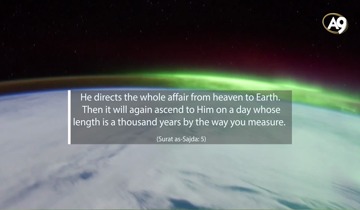
“He directs the whole affair from Heaven to Earth. Then it will again ascend to Him on a Day whose length is a thousand years by the way you measure.” (Surat as-Sajda, 5)
The second way of bending time is through enormous masses. General Relativity says that the stronger gravity is, the more slowly time flows. A single hour spent at the edge of a black hole could be equivalent to an entire lifetime on Earth. In fact, you do not need to travel to distant galaxies to understand this. The maps on the phone in your pocket right now, namely the GPS system, must calculate this bending every second. Because satellites are far from Earth, gravity is weaker there, and the clocks on satellites run microseconds faster per day than those on Earth. If Einstein’s time-bending equations did not exist, the navigation on your phone would take you kilometers away from the correct location every day.
So, what does the bending of time tell us? If time can stretch, what is “past” for one person may be “now” or “future” for another. This brings us to that crucial question: If the flow of time changes from person to person, are we living in a “Block Universe” model in which all times—the past, present, and future—exist at the same time?
Einstein’s laws of relativity tell us this: An event that is in the future for you may already be in the past for an observer elsewhere in the universe who is moving at a different speed. Imagine the universe as a huge loaf of bread. What you call “now” is a thin slice cut from the middle of this bread. Your past is at one end of the bread, and your future is at the other. But the bread is a whole, and all the slices are there at the same time.
When his closest friend Michele Besso died, Einstein said the following in a letter he wrote to his family:
“People like us, who believe in physics, know that the distinction between past, present and future is only a stubbornly persistent illusion.”
Albert Einstein
According to this perspective, the moment you were born, the moment you are watching this documentary now, and the moment you will die... They are all coordinates fixed within the space-time block. Just as on a DVD disc, all scenes are there at the same time, but the laser reader can access those frames only in sequence.
This magnificent structure, which science calls the “Block Universe,” is in fact nothing other than a manifestation of divine artistry and infinite knowledge. Each of those infinite frames that we call destiny has been constructed in the finest detail by God, the Creator of time and space. The future, which is unknown to us, and the past, part of which we cannot remember, are “an evident present” in His Presence.
Because He is outside the time and space He created. He is not dependent on them; He is their Sovereign. While the human being is imprisoned within his own limited perception of time, God, with His eternal and everlasting knowledge, sees every falling leaf, every beating heart, and the outcome of every hidden intention at the same time.
Our Lord has declared this truth in all its magnificence in Surat al-An‘am as follows:
I seek refuge in God from the accursed satan.
“The keys of the Unseen are in His possession. No one knows them but Him. He knows everything in the land and sea. No leaf falls without His knowing it. There is no seed in the darkness of the ground, and nothing moist or dry that is not in a Clear Book.” (Surat al-An‘am, 59)
Will
Throughout history, the human being has regarded himself as a being who chooses, decides, and possesses will. We also feel this way in daily life. We think that we decide what we will drink, which road we will take, and what we will say. So, do these decisions belong to us as much as we think they do?
“I wanted it.” “I decided.” “I did it.” These sentences spill from our lips at every moment of life. But what if these words do not tell the whole truth? What if the human being is merely a witness who becomes aware of what is happening? Throughout human history, the concept of free will was based on the idea that people themselves controlled everything they did and all the decisions they made. But today, science presents new findings that shake this old, false belief.
Scientists have discovered that something begins deep within our brains before we make decisions. This brings to the agenda the debate that our will may in fact be an illusion. These scientific findings carry a meaning exactly similar to the concept of destiny conveyed to us in the divine religions. For centuries, free will was an abstract concept discussed only in the misty rooms of philosophy.
However, in the 1980s, Benjamin Libet brought this ancient question under the cold light of the laboratory. Libet was pursuing that mysterious moment hidden in the recesses of our minds: the first second in which we make a decision. In Libet’s experimental setup, while the subjects looked at the face of a clock, they moved their wrists at any moment they wished and recorded the moment when this desire reached their consciousness. At the same time, the subjects’ brain activities were monitored with special devices. The results delivered the first major blow to the perception of will. Before the person was even aware of the desire to move, the brain began producing an electrical signal called the readiness potential approximately 350 to 550 milliseconds earlier. This hidden signal awakened half a second before we said, “I am doing it now.” It was as though, while we thought we were the captain, the ship had already left the harbor.
| Process Component | Timing (milliseconds) | Explanation |
| Beginning of Readiness Potential (RP) | -550 ms | The brain unconsciously initiates the action. |
| Conscious Desire/Intention (W Time) | -200 ms | The moment the person says, “I want to move.” |
| Physical Action (M Time) | 0 ms | The moment the muscle movement occurs. |
| Decision-Awareness Delay | ~350 ms | The time required for the brain to report the decision to consciousness. |
On this sensitive scale, where time was measured in milliseconds, the true story of our will had emerged. This timeline whispers the following to us. Approximately 350 milliseconds before we say that we have decided—that is, within the time it takes to blink—our brain has already made the decision. This delay is the time required for the brain to report the decision it has made to our mind. Consequently, this table shows that our decisions are the outcome not of a conscious process, but of biological preparation.
I seek refuge in God from the accursed satan.
“... you did not throw, when you threw; it was God Who threw... ” (Surat al-Anfal, 17)
Although criticisms have been raised against Libet’s experiment, such as the clock face being distracting and the unreliability of people reporting their own feelings, twenty-first-century technology has not refuted these data; on the contrary, it has deepened them further. Libet’s milliseconds were the first small crack opened in our fortress of free will. But in 2007 in Berlin, John-Dylan Haynes and his team turned this crack into a gigantic doorway. This new point reached by science was deeply shaking our most deeply rooted belief about ourselves: the illusion that we make our decisions “at that instant.”
At the Bernstein Center in Berlin, technology penetrated the most private place of the human mind, that dark void where intentions are born. Using the enormous magnetic power of the MRI device, John-Dylan Haynes asked the following question: “Could your brain know what you are doing before you decide which hand you will use to press a button?”
The subjects waited silently, watching for the appropriate moment to choose either their right or left hand. The moment of choice is perceived by everyone as a process occurring “at that instant.” Yet deep within the brain, in the frontopolar cortex region, a storm had already begun to break. The results of the research created an earthquake effect in the scientific world: The patterns of activity in our brains revealed which hand we would choose a full 7 to 10 seconds before we had even whispered our choice to our consciousness.
Even when the “hemodynamic delay,” the natural 3-second delay in blood flow, was taken into account, the decision had already been made, sealed, and set in motion. By looking only at the signals in this region of the brain, scientists could predict with great accuracy which button the person would press while the person himself did not yet know. That is to say, in the second when you think you have made a free choice, you are actually experiencing the final link—the “announcement”—of a process your brain began approximately 7 seconds earlier.
Our conscious choice is merely delayed thunder; whereas the electrical storm of the decision has flashed in the silent skies of the brain seconds before we hear its sound.
God, the sole Possessor of power, reminds us in the Qur’an as follows that our will comes to life only through His willing:
I seek refuge in God from the accursed satan.
“But you will not will unless God wills...” (Surat al-Insan, 30)
Science has gone beyond the limits of indirect methods such as fMRI (functional magnetic resonance imaging) and EEG (electroencephalogram) and has now succeeded in descending to that microscopic center where consciousness is knotted together with biological reality, directly into the heart of the neurons. On this new horizon, in the year 2011, Itzhak Fried, through electrodes placed in the minds of epilepsy patients, observed second by second the hidden “birth pains” of a thought before it was even born.
Fried’s observations were striking: Before the volunteer had yet decided to move his finger, exactly 1.5 seconds before the action, neurons deep within the brain began a hidden preparation. With 700 milliseconds remaining until the moment of decision, the researchers were now like seers; they knew, with an accuracy exceeding 80%, when the person would act, while the person himself did not yet know.
Fried’s model tells us this: What we call will consists merely of crossing a neural threshold. When the activity passes that invisible boundary, the action is triggered automatically, and this physical reality reaches our consciousness like a whisper:
“I decided,” we say. Yet in reality, conscious will is not the architect of the decision, but the astonished observer of a completed process.
The feeling that the human being is the absolute sovereign of his own decisions is the product of a master fiction-maker hidden in the left hemisphere of the brain, namely the “left-hemisphere interpreter.” This mechanism, defined by Michael Gazzaniga, sews logical coverings onto actions that have already been completed outside consciousness, immediately after the event. Seconds later, our brain tells the following tale to a body that has jumped in fear: “I decided to jump because I thought the toy on the ground was a snake.”
Yet the command to jump was issued from the dark corridors of the amygdala without consulting the conscious mind. Later, a story was fabricated in the left brain about why this decision had been made. The human brain is a storyteller that dislikes gaps and is in love with the illusion of consistency.
In this process, dopamine works like the ink of an invisible destiny. According to research by the Salk Institute, dopamine waves rising in the basal ganglia immediately before the moment of decision encode which option will be preferred long before the action. The intensity of dopamine is, as it were, a mathematical preview of the choice to be made.
When we bring all these data together, a striking picture appears before us: While we are not yet aware, our brain makes decisions, takes action, and then tells our consciousness an elegant tale as though we had made that decision. While we think we are the directors of our own lives, we are in fact admiring spectators of a script written for us.
So, can this brain, which at the subatomic level consists only of energy and at the supra-atomic level consists of a handful of flesh, form an intention on its own? Can a piece of flesh display a will by saying, “Now let me control this person and make him experience the feeling of the illusion of decision”?
Matter cannot carry a will that does not belong to it. This magnificent mechanism that science calls the “brain” is in fact a unique means offered to our soul by our Lord, Who brings us into existence anew at every moment. The neuronal firings we see, the rising dopamine waves, and those hidden 7-second preparations are in fact the fingerprints of divine artistry.
These laboratory results presented to us by science were a truth that had already always been known in the true religions from the very beginning.
It is precisely at this point that we understand what the concept we know as Oneness of God (Tawhid) actually means. God is the sole Possessor of will in the universe. Apart from Him, there is no independent power in the universe that can move even a single particle from its place.
Our Lord has brought into existence our journey in the world, each of our decisions, and all our actions beyond time, in the dimension of timelessness.
While the human being is unaware of those complex physical and mathematical equations that lie behind even his simplest and most ordinary movement and are constantly being calculated, he falls into the illusion that he is the absolute director of everything. Yet every frame of this magnificent order has been created and brought to completion by God in destiny.
Absolute authority and infinite power belong to Him alone. No decision can be made on Earth without His permission, and no particle can move outside His knowledge. Every intention that we call “my decision” consists merely of the echo in our heart of His command “Be.”
I seek refuge in God from the accursed satan.
“[He is] the Originator of the heavens and earth. When He decides on something, He just says to it, “Be!” and it is.” (Surat al-Baqara, 117)
A Single Moment
The lamps of the sky had not yet been lit, and the stars had not been scattered into the void like pearls. Neither this space that appears infinite nor the time whose every second we count existed. Even nonexistence did not exist. There was only God, the Creator of everything. He Who is beyond time and space, encompasses everything, and possesses the Command “Be.” Our Lord said, “Be.” And it was.
Many people think that the Big Bang was an event that occurred and ended in the past. Yet we are still within that single moment. Our millions of years of time and our distances of billions of kilometers are all contained within this single moment of expansion. The explosion is still continuing. Everything is still moving away from everything else. Our entire destiny is hidden within a single moment, within a single command of creation.
Modern Physics places new questions before us. If that first explosion began with that tremendous energy density, was everything already determined “at the very beginning”? Was the entire story of the universe written on the very first page?
In his work Until the End of Time, theoretical physicist Brian Greene describes the human being as a bag of atoms implementing the laws of physics and characterizes free will as a sensation of making a choice. And despite the reality of this feeling, he argues that the choice itself is a physical illusion. The laws of physics have operated unchangeably since the beginning of the universe. In classical mechanics, if the positions and momenta of all the particles in a system at a particular moment are known, all its future states can be calculated with formulas. This was a mathematical decree. It was understood that, based on yesterday’s data, today’s state had been determined by equations. No one had any chance of stopping or changing this mathematical flow. Everything had been sealed until the very end.
When a human being thinks that he has made a decision, what is actually happening is that the atoms and molecules in his brain are moving in one direction or another according to the laws of physics. This movement is dictated by the mass and charge of the particles and the forces between them. We experience a high-level construction of a script written at the level of particles.
Some thinkers argue that the uncertainty principle in quantum mechanics could make room for free will. However, Greene states that quantum randomness does not save the concept of free will; on the contrary, it makes it even more complex. Although events at the quantum level are considered probabilistic, these probabilities are subject to strict mathematical rules such as the Schrödinger equation. More importantly, the alleged randomness is not the same thing as will. Even if a person’s actions are the result of random quantum fluctuations in his brain, those actions cannot be regarded as having been chosen by that person. On the contrary, the person becomes a passive observer of his own actions.
The feeling of free will arises from our inability to witness the operation of the laws of nature at the fundamental level. Our senses cannot perceive the firing of billions of neurons in our brain or the movement of neurotransmitters at the molecular level. We perceive only the high-level outputs of these physical processes, namely intentions and desires.
When an individual decides to raise his arm, this action actually emerges as a result of light striking the retina, the transmission of nerve signals, and a chain of complex chemical reactions in the motor cortex. However, because we do not see these subprocesses, we feel as though the action were initiated at that moment by an autonomous self. This is similar to seeing the movement of pixels on a computer screen while failing to notice the complex software codes and hardware processes behind them.
For every single second, the position of all particles was determined and completed “at the very beginning” by God, the Sovereign Owner of the dominion. At this very “moment,” we are witnessing a boundless universe and an immense span of time produced by an explosion that occurred suddenly. All of this is taking place within a single moment. Everything we know and comprehend came into existence through the explosion of a nonexistence. All this magnificence consists of manifestations of our Lord’s infinite intellect and incomparable power, which He has embroidered from our destiny and shown to us.
I seek refuge in God from the accursed satan.
“Say: ‘Nothing can happen to us except what God has ordained for us. He is Our Master. It is in God that the Muslims should put their trust.’” (Surat at-Tawbah, 51)
One of the most controversial and profound subjects in modern physics is whether the fundamental operation of the universe is random or determined. Since the beginning of the 20th century, while quantum mechanics has argued that nature possesses an essentially probabilistic structure, figures such as Albert Einstein opposed this act of “throwing dice.” One of the most important present-day representatives of this intellectual legacy is Nobel Prize-winning Dutch physicist Gerard ’t Hooft. He compares the universe to a gigantic cellular automaton, that is, a tremendous digital system in which every step depends on the preceding one. What we call uncertainty is merely a condition arising from our inability to see the immense information in this infrastructure.
In that smallest interval of time at the Planck scale, everything flows with clock-like precision and in a determined manner. ’t Hooft’s fundamental thesis is that, at the lowest level of nature, there are definite states that he calls ontological states. These states pass definitively from one step to the next within the framework of specific physical laws. The uncertainties and superpositions in the quantum world that we observe are an illusion arising from our inability to see fully the immense amount of information in this infrastructure.
Planck time, namely 10-43 seconds, is the shortest interval of time in which the known laws of physics are meaningful. According to ’t Hooft’s theory, the deterministic processes underlying the universe occur on this incredibly short time scale. In other words, the atom’s next movement for any given second is already determined. However, for a human being to obtain this information in advance would require knowing all the initial variables of the universe and the states of billions of particles, which is practically impossible.
According to ’t Hooft, the choice that the experimenter believes he makes freely is in fact also a result of the conditions at the beginning of the universe. This approach is called superdeterminism. In superdeterminism, which button the experimenter will press has already been coordinated with the state of the particle to be measured at the beginning of the universe, during the Big Bang. For this reason, the experimenter cannot make a choice independent of the system. In other words, everything in the universe, including human decisions, is part of a chain originating at the beginning. This means absolute destiny in the scientific sense.
Everything witnessed by our soul—our perceptions, our feelings, and every decision we make—is created by God in every detail. Every moment of every human being, from the state in which he is still a single cell to the moment he first learns to read and write, from the answers he gives in a university examination to which company he will work for and what job he will do throughout his life, how many times he will sign which papers, and where and how he will die, is known in the Presence of God.
When a materialist is told the truth that we never have direct contact with the original of matter and that time is only a perception, he is seized by great terror. This is because matter and time are the only concepts to which he is attached, regarding them as absolute existence. They are, as it were, idols that he worships. For he believes that he himself was created by matter and time. When he senses that the universe in which he thinks he lives, his own body, and even the philosophers whose ideas influence him are merely perceptions, a profound fear surrounds his entire being.
However, this truth has exactly the opposite meaning for believers. Those who believe in God experience great joy when they comprehend the secret behind matter. This is because this truth is a unique key that opens every lock. The moment this lock is opened, all secrets come to light. When this secret is comprehended, questions such as when and where lose their meaning. When spacelessness is understood, it is realized that Paradise, Hell, and the world are in fact in the same place. When timelessness is comprehended, it is seen that everything happens and is completed within a single moment. There is no longer a future to be awaited or a time that passes away.
With the realization of this secret, the world begins to resemble Paradise for a believer. All material anxieties, apprehensions, and fears that distress a person disappear in an instant. The person understands that the entire universe has a single Sovereign and that He directs the whole world as He wills. He has now submitted to God, liberated from every kind of dependence, as stated in the Qur’an. This is the truth. No human being has any friend or helper other than God. He is the only absolute Being in Whom refuge is to be sought and from Whom help is to be requested. And wherever we turn, there is the Face of God.
I seek refuge in God from the accursed satan.
“They said, Exalted are You; we have no knowledge except what You have taught us. Indeed, it is You Who is the Knowing, the Wise.” (Surat al-Baqara, 32)